
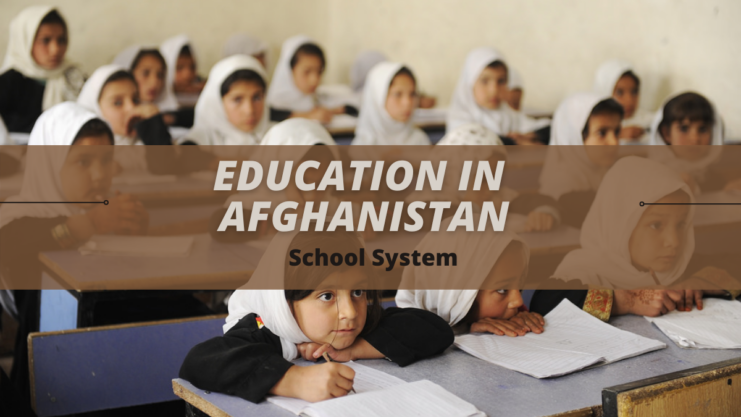
Two separate systems of education exist in Afghanistan. The older system is a religious one, taught by the mullahs, who conduct schools in the village mosques. They teach the religious precepts of the Koran, reading, writing, and arithmetic.
The other system was introduced in Afghanistan’s 1964 constitution and provided for free and compulsory education at all levels. Prior to the civil war the respected Kabul University (founded in 1932) was a major seat of learning with free tuition.
Nine other colleges were established within it from 1938 through 1967, each with assistance from such countries as France, Germany, the United States, Egypt, and the USSR. Before 1961 only men could receive higher education; that year all faculties were made coeducational. University of Nangarhar (1962) in Jalalabad was established to teach medicine and other disciplines.
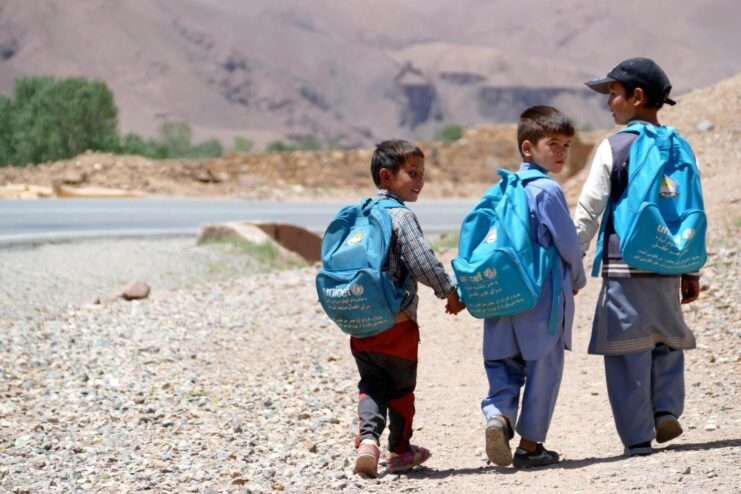
Before the 1978 military coup, the public school system was based on Western models. Special emphasis was placed on primary education. Secondary schools existed in Kabul and the larger towns. Twelve years of primary and secondary schooling were expected, although many Afghans could not attend because they lived in areas where there were no schools.
In the mid-1980s the country had about 800 primary schools and 300 general secondary schools. Kabul University had about 6500 students. Literacy was estimated to be about 29 percent for all Afghans aged 15 and older in 1990, about 44 percent for males and about 14 percent for females.
However, some experts believe these figures are too high since up to 80 percent of the schools had been destroyed by this time; warfare effectively eliminated most education thereafter and a generation grew up without any formal schooling.
To better meet educational needs the United States government and the University of Nebraska at Omaha helped design a mobile school system with teaching materials that were printed on fabric and carried all over Afghanistan to teach basic skills.
The current civil war has caused the closing or dismantling of the most lower, middle, and higher education facilities. After the 1978 coup, 36 faculty members from Kabul University were executed and 260 fled the country.